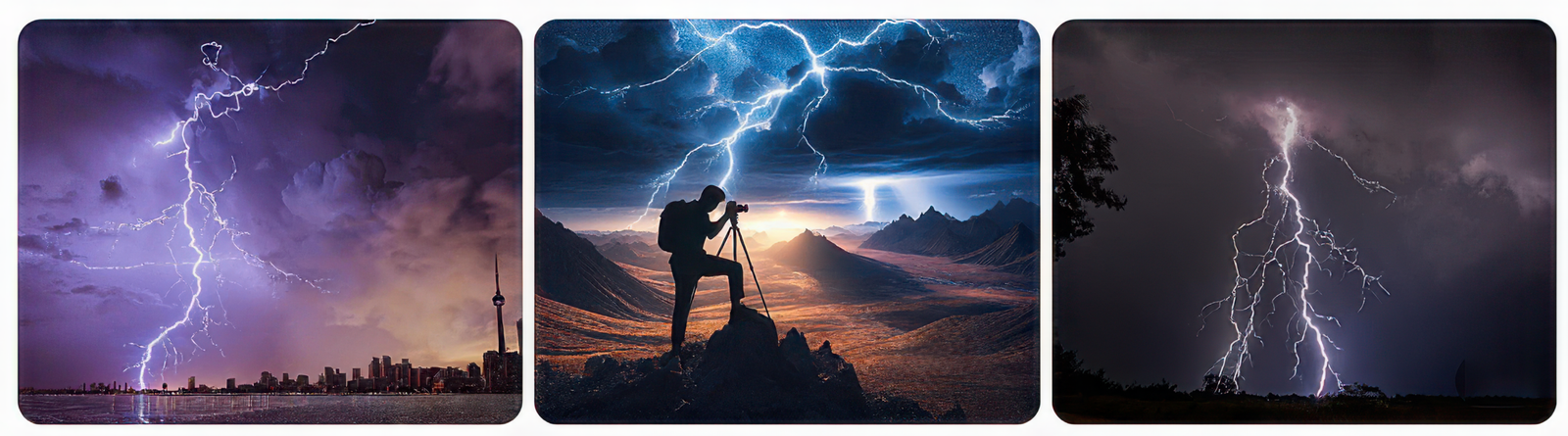
Settings, Timing & Safety Tips
Lightning photography is one of the most thrilling experiences a photographer can have. There’s something almost addictive about watching a storm build, waiting for that sudden flash, and capturing a moment that lasts only a fraction of a second. When everything comes together, the result can be breathtaking—jagged bolts of light cutting across dark skies, illuminating entire landscapes in an instant.
But photographing lightning isn’t just about luck. It’s about preparation, patience, and understanding how to work with unpredictable conditions. Unlike most subjects, you can’t simply point your camera and press the shutter at the right moment. Lightning demands a different approach—one that combines technical knowledge with awareness and, above all, safety.
Because as exciting as it is, lightning is also dangerous. And no photograph is worth putting yourself at risk.
Understanding the Challenge of Lightning Photography
The biggest challenge with lightning is timing. A lightning strike happens in milliseconds, far faster than human reaction time. Trying to press the shutter the moment you see it simply doesn’t work consistently.
Instead, lightning photography is about increasing your odds.
You’re not reacting to the strike—you’re preparing your camera so that when the strike happens, it’s already capturing the scene. This is why long exposures play such a critical role. By keeping the shutter open for extended periods, you give your camera time to record lightning when it occurs within that window.
Once you shift your mindset from “catching lightning” to “creating opportunities to capture it,” everything starts to make more sense.
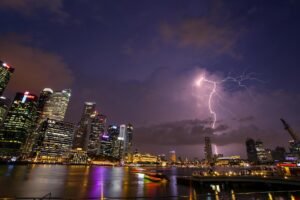
Choosing the Right Location
Where you shoot from matters just as much as how you shoot. A strong composition can turn a simple lightning strike into a powerful image.
Open areas with a clear view of the sky work best. Elevated viewpoints, distant horizons, or city skylines can add depth and context to your photos. Including foreground elements—such as buildings, trees, or water—helps ground the image and gives scale to the lightning.
But safety must always come first.
Avoid exposed areas like hilltops, open fields, or near isolated trees during active lightning. These are high-risk locations. Shooting from inside a vehicle is often one of the safest options, allowing you to stay protected while still capturing the storm.
Distance is your friend. The most dramatic images don’t require you to be directly under the storm. In fact, shooting from a distance often produces cleaner, more defined lightning with less risk.
Best Camera Settings for Lightning Photography
Getting your camera settings right is essential, but fortunately, lightning photography follows a fairly consistent approach once you understand the basics.
A tripod is non-negotiable. Because you’ll be using longer exposures, stability is critical. Even slight movement can blur your image, especially in windy conditions.
A mid-range aperture—typically around f/8—provides a good balance of sharpness and light control. Lightning is extremely bright, so a narrower aperture helps prevent overexposure while keeping the scene crisp.
ISO should be kept low, usually around ISO 100. This reduces noise and preserves detail, particularly in dark skies.
Shutter speed is where the real technique comes in. At night, exposures of several seconds—sometimes 10 to 30 seconds—work well. During the day or in brighter conditions, shorter exposures may be necessary, often combined with a neutral density filter to reduce incoming light.
Instead of trying to time each shot manually, many photographers use continuous shooting or interval timers. This allows the camera to take multiple exposures back-to-back, dramatically increasing the chances of capturing a strike.
Timing the Shot (Without Timing the Shot)
This is where lightning photography becomes almost counterintuitive.
You’re not trying to press the shutter at the exact moment lightning strikes. You’re creating a continuous window where your camera is always ready to capture it.
At night, this is relatively straightforward. Long exposures give you a wide window, and if lightning strikes during that time, it will appear in your image.
During the day, it becomes more challenging because exposures must be shorter. This is where techniques like rapid continuous shooting or using a lightning trigger device can help.
But even without specialized gear, patience plays a huge role. The more frames you capture, the better your chances.
Think of it as fishing—you’re casting your line repeatedly, waiting for the right moment.
Focusing in Low Light
Autofocus can struggle in storm conditions, especially at night or in low-contrast scenes. Switching to manual focus is often the best approach.
Focusing at or near infinity works well for distant lightning, but it’s important to fine-tune this rather than relying on the lens’s infinity mark alone. Using a distant light source or zooming in on your LCD screen to confirm focus can help ensure sharp results.
Once focus is set, avoid adjusting it unless your composition changes significantly.
Working with Highlights and Exposure
Lightning is one of the brightest natural phenomena you’ll ever photograph, which makes exposure control critical.
It’s very easy to blow out highlights if your exposure is too bright. This is where a key principle comes into play: protect the highlights.
Slightly underexposing your image helps preserve the detail and structure within the lightning bolt itself. This aligns with a more advanced approach to exposure—prioritizing highlight retention while allowing shadows to fall where they may.
If you’re shooting in RAW format, you’ll have much more flexibility to lift shadows later without losing quality. This combination—underexposing slightly and shooting in RAW—gives you the best chance of capturing both the intensity of the lightning and the detail in the surrounding scene.
Safety: The Most Important Part of the Process
It can’t be said enough—lightning photography comes with real risk.
If you can hear thunder, you are close enough to be struck. That’s the baseline rule.
Avoid standing in open areas, near tall isolated objects, or close to water during a storm. Keep your gear minimal and your setup quick, so you can move if conditions change.
Shooting from inside a vehicle is one of the safest approaches. If you’re outside, stay aware of your surroundings at all times and be ready to leave immediately if the storm moves closer.
No photo is worth your safety. The best lightning photographers are the ones who know when to stop.
Patience, Practice, and a Bit of Luck
Even with perfect settings and positioning, lightning photography involves an element of unpredictability. You won’t capture a perfect strike every time—and that’s part of the process.
The more you practice, the better you’ll become at reading storms, anticipating where lightning will appear, and refining your technique. Over time, what once felt like luck starts to feel like skill.
And when you finally capture that perfect bolt—sharp, dramatic, perfectly placed—it’s worth every minute of waiting.
Final Thoughts
Photographing lightning is one of the most rewarding challenges in photography. It pushes your technical skills, tests your patience, and forces you to think differently about timing and exposure.
By using long exposures, choosing safe locations, protecting your highlights, and working in RAW when possible, you give yourself the best chance of success.
But above all, remember this: respect the storm.
Do that, and you’ll not only capture incredible images—you’ll walk away ready to do it again.